
Happy Independence Day, America!

Have a wonderful Fourth of July…God Bless the USA!

DCG

Sunday Devotional: Power is made perfect in weakness

2 Corinthians 12:7-10

Brothers and sisters:
That I, Paul, might not become too elated,
because of the abundance of the revelations,
a thorn in the flesh was given to me, an angel of Satan,
to beat me, to keep me from being too elated.
Three times I begged the Lord about this, that it might leave me,
but he said to me, “My grace is sufficient for you,
for power is made perfect in weakness.”
I will rather boast most gladly of my weaknesses,
in order that the power of Christ may dwell with me.
Therefore, I am content with weaknesses, insults,
hardships, persecutions, and constraints,
for the sake of Christ;
for when I am weak, then I am strong.

The above passage from St. Paul’s letter to the Corinthians is a puzzle and a seeming contradiction, for how can power be made perfect in weakness?

The answer is in the sentence from which the phrase is lifted. The complete sentence reads:

Three times I begged the Lord about this, that it might leave me, but he said to me, “My grace is sufficient for you, for power is made perfect in weakness.

In other words, instead of asking that we be spared life’s inevitable problems, challenges  and tragedies — the nefarious consequences of Adam and Eve’s sin — we are told to trust in God and to turn to Him for help. And when we do that, God will manifest His power in us, and we will find strength and fortitude, for “I can do all things through Christ who strengthens me” (Philippians 4:13). His power will be made perfect in our weakness.

The post that immediately precedes this post is an example.

The past year of COVID-19 quarantines and lockdowns had exacted a terrible toll not just in business closures and unemployment, but also on our mental health. According to Harvard Medical School professor David H. Rosmarin:

  • The incidence of mental disorders increased by 50%.
  • Alcohol and other substance abuse surged.
  • Young adults were more than twice as likely to seriously consider suicide than they were in 2018.

The only group whose mental health actually improved during the past year were those who attended religious services at least weekly, in-person or online. 46% of religious Americans said their mental health was “excellent” — an increase of 4% from a year ago.

Pretty amazing, isn’t it.

~E

Religious Americans are only group whose mental health improved during coronavirus pandemic

We have evidence from study after study of the beneficial effects of religious faith on one’s physical and mental health.

Here’s the latest.

In “Psychiatry Needs to Get Right with God,” for Scientific American, June 15, 2021, David H. Rosmarin, an associate professor at Harvard Medical School and director of the McLean Hospital Spirituality & Mental Health Program, writes:

In the past year, American mental health sank to the lowest point in history: Incidence of mental disorders increased by 50 percent, compared with before the pandemic, alcohol and other substance abuse surged, and young adults were more than twice as likely to seriously consider suicide than they were in 2018. Yet the only group to see improvements in mental health during the past year were those who attended religious services at least weekly (virtually or in-person): 46 percent report “excellent” mental health today versus 42 percent one year ago. […]

My own research has demonstrated that a belief in God is associated with significantly better treatment outcomes for acute psychiatric patients. And other laboratories have shown a connection between religious belief and the thickness of the brain’s cortex, which may help protect against depression.

~E

Saturday funnies!

DCG

Puppies are born with the ability to understand humans

No wonder dog is man’s best friend.

A new study found that puppies are born with the innate ability to understand human communications or “social cognition”. The communications include humans’ gestures, speech, and facial expressions.

, et al., write in Current Biology, June 3, 2021:

Human cognition is believed to be unique in part because of early-emerging social skills for cooperative communication. Comparative studies show that at 2.5 years old, children reason about the physical world similarly to other great apes, yet already possess cognitive skills for cooperative communication far exceeding those in our closest primate relatives.

A growing body of research indicates that domestic dogs exhibit functional similarities to human children in their sensitivity to cooperative-communicative acts. From early in development, dogs flexibly respond to diverse forms of cooperative gestures.

Like human children, dogs are sensitive to ostensive signals marking gestures as communicative, as well as contextual factors needed for inferences about these communicative acts.

However, key questions about potential biological bases for these abilities remain untested. To investigate their developmental and genetic origins, we tested 375 8-week-old dog puppies on a battery of social-cognitive measures. We hypothesized that if dogs’ skills for cooperating with humans are biologically prepared, then they should emerge robustly in early development, not require extensive socialization or learning, and exhibit heritable variation. Puppies were highly skillful at using diverse human gestures, and we found no evidence that their performance required learning. Critically, over 40% of the variation in dogs’ point-following abilities and attention to human faces was attributable to genetic factors. Our results suggest that these social skills in dogs emerge early in development and are under strong genetic control. […]

Our findings show that, from early in development, puppies are highly sensitive and receptive to diverse communicative signals from humans, including gestures and speech, and that variation in these traits is under strong genetic control. Our study design also controls for several alternative explanations. First, subjects were tested at ∼8 weeks, when they were still living with their littermates and eating, sleeping, and spending most of their time with conspecifics rather than humans. Despite their limited experience with humans, puppies were highly skilled at following human gestures and motivated to attend to and interact with humans. Second, our sample size of 375 puppies permitted a powerful analysis of potential learning effects during gesture-following tasks. These analyses confirmed that puppies were skillful from the very first test trial, and that their performance did not improve across trials.

The researchers maintain that puppies’ ability to understand human communications is “a byproduct of selection for tamability, a phenotype believed to have been targeted during dog domestication.”

~E

Your prayers are needed!

Auntie Lulu of FOTM, aka Grace Storvika on Body and Soul, fell and “shattered” two bones near her wrist, and was in the hospital until two days ago.

She writes:

“I would greatly appreciate everyone’s prayers for a swift and  complete recovery.”

I know how awful her injury is because last October, I made the stupid mistake of reaching for the ceiling while standing on a stool. I fell and sprained my left wrist. To this day, eight months later, that wrist is still not completely healed, although most of the functions are restored.

I can only imagine how broken wrist bones would be worse — much, much worse.

So, please join me in saying a prayer for Auntie Lulu — that her broken bones heal quickly, and that she will regain full use of that wrist, hand, and arm.

Thank you.

~E

Wednesday Funny: Cats like to sit even in illusory boxes

Cat owners know that their fur-babies love to sit in bags, baskets, and boxes.

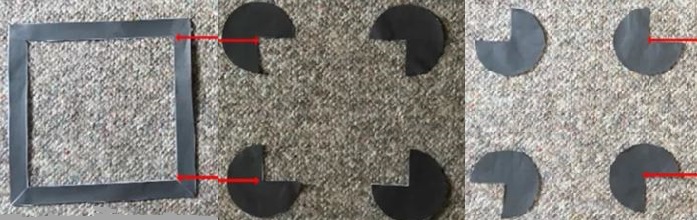
But a new study found that cats would sit even in “boxes” that are optical illusions!

Emma Young reports for the British Psychological Society’s Research Digest, May 24, 2021, that a new study by Gabriella E. Smith at City University of New York and colleagues, published in Applied Animal Behaviour Science, found that cats treated an illusory square as a real square.

Of the 500 pet cats and owners who signed up to take part, 30 completed all the trials. The owners were not told the purpose of the experiment. 

Every day for six days, each owner put their cat out of the room while they taped a pair of stimuli to the floor. The researchers instructed them each day on which two of three stimuli to use:

  1. An actual square.
  2. An illusory Kanizsa square, in which four Pacman-type cut-outs are arranged to suggest the lines of a square.
  3. The Kanizsa control, in which the Pacman-type cut-outs face the other way, so that there is no illusion of a square.

The owner then put on sunglasses (so their cat couldn’t use the owner’s gaze as a cue to what to do), brought the cat into the room, and started videoing. If, within five minutes, their cat sat or stood within either of the shapes, the trial ended. Either way, after five minutes, they submitted the result.

Of those 30 cats who completed all the trials:

  • On 8 occasions, a cat sat inside an actual square.
  • On 7 occasions, a cat sat inside a Kanizsa square.
  • A cat sat inside the Kanizsa control only once.

This suggests that cats treat the illusory Kanizsa squares just like real ones.

~E

Men rescue couple bucks stuck in barbed wire fence

Great job, guys!

DCG

Man nurses baby hummingbird; cardinal chirps ‘goodbye’

We have a two bird stories this morning.

(1) A kind man nurses a baby hummingbird:

(2) A rescue cardinal chirps “goodbye” to woman:

~E

Sunday Devotional: God did not make death

Wisdom 1:13, 2:23-24

God did not make death,
nor does he rejoice in the destruction of the living. […]
For God formed man to be imperishable;
the image of his own nature he made him.
But by the envy of the devil, death entered the world,
and they who belong to his company experience it.

Mark 5:21-23, 35-42

When Jesus had crossed again in the boat
to the other side,
a large crowd gathered around him, and he stayed close to the sea.
One of the synagogue officials, named Jairus, came forward.
Seeing him he fell at his feet and pleaded earnestly with him, saying,
“My daughter is at the point of death.
Please, come lay your hands on her
that she may get well and live.” […]
While he was still speaking,
people from the synagogue official’s house arrived and said,
“Your daughter has died; why trouble the teacher any longer?”
Disregarding the message that was reported,
Jesus said to the synagogue official,
“Do not be afraid; just have faith.”
He did not allow anyone to accompany him inside
except Peter, James, and John, the brother of James.
When they arrived at the house of the synagogue official,
he caught sight of a commotion,
people weeping and wailing loudly.
So he went in and said to them,
“Why this commotion and weeping?
The child is not dead but asleep.”
And they ridiculed him.
Then he put them all out.
He took along the child’s father and mother
and those who were with him
and entered the room where the child was.
He took the child by the hand and said to her, “Talitha koum,”
which means, “Little girl, I say to you, arise!”
The girl, a child of twelve, arose immediately and walked around.
At that they were utterly astounded.

That first sin by our first parents in the garden was so cataclysmic that it fundamentally changed the natural order of the world: A door was opened to chaos; henceforth a price must be paid for being human. Where once was joy and ease, there would be banishment, toil, pain, hardship, sickness, disease, and eventual death — for dust you are and to dust you will return”.

But as Wisdom 1:13 reminds us, God did not make death, nor does he rejoice in the destruction of the living.” Through the sacrifice of the Second Person of the Triune Godhead, we are promised that as His followers, we too will rise from the dead.

That promise is given vivid testimony in the accounts of Jesus raising not just Lazarus, but Jairus’ little daughter, from the dead.

So, on this glorious Sunday morning, rejoice!

~E