~E

Nikkei Asia reports on Feb. 12, 2021 that Japan Prime Minister Yoshihide Suga added a new post to his cabinet when he appointed Tetsushi Sakamoto to be a minister of loneliness, charged with coordinating efforts across multiple ministries and agencies to alleviate social isolation.
Telework and the lack of social gatherings during Japan’s fight against COVID-19 have left people feeling increasingly stressed and lonely. Older Japanese who are not used to communicating online have become more isolated from the outside world. Even younger, tech-savvy Japanese have struggled with protracted social-distancing efforts. Closed offices and schools mean they have less contact with colleagues and friends. Many have also lost jobs, adding economic stress to their situation.
The Japanese government believes pandemic-linked isolation accounts for the first uptick in suicides in 11 years, by 750 to 20,919 in 2020. This is the first increase since 2009, just after the global financial crisis.
Japan already had the highest suicide rate out of any of the Group of Seven leading industrial nations, at 14.9 suicides per 100,000 individuals, according to the Organization for Economic Cooperation and Development. Much of these deaths have been attributed to health and economic problems, which could only worsen as the coronavirus pandemic drags on.
Suga in particular noted a rise in suicides among women. While suicides among men fell for the 11th straight year, suicides among women rose for the first time in two years to 6,976. A total of 440 elementary, middle and high school students had also died by suicide as of November, the highest number since 1980.
Suga said: “Women especially are feeling more isolated and face increasing suicide rates. I hope to promote activities that prevent loneliness and social isolation and protect the ties between people.”
Japan’s government has yet to come up with specific measures to address the situation. But it could model its efforts after the U.K., which appointed a minister for loneliness and published a “Loneliness Strategy” in 2018. Government surveys now include loneliness as a topic. London works with local governments and volunteer organizations to assist at-risk groups like the youth and the unemployed. Research has found that at least 13% of UK’s population felt alone, and that disconnected communities may be costing the British economy £32 billion ($44 billion) a year.
In the United States, according to a 2016 Mercator Net report, about one in three people older than 65 live alone, and studies show 10% to 46% of those older than 60 are lonely.
Dr. Carla M. Perissinotto, a geriatrician at the University of California, San Francisco, calls the epidemic of loneliness a public health crisis. She says, “The profound effects of loneliness on health and independence are a critical public health problem. It is no longer medically or ethically acceptable to ignore adults who feel lonely and marginalized.”
A study she conducted showed that, among adults over 60, those who reported feelings of loneliness had significantly higher rates of declining mobility, difficulty in performing routine daily activities, and death during 6 years of follow-up. This association remained significant even after taking into account people’s age, economic status, depression and other health problems.
University of Chicago neuroscience researcher John T. Cacioppo, who studies the social nature of the human brain, puts loneliness on the same instinctive level as thirst, hunger or pain – as a survival mechanism. In an interview he says:
“One of the things that surprised me was how important loneliness proved to be. It predicted morbidity. It predicted mortality. And that shocked me. When we experimentally manipulated loneliness, we found surprising changes in the “personalities” of people. There’s a lot more power to the perception of being socially isolated than any of us had thought.”
Cacioppo’s research has shown links to high blood pressure and impaired immune responses. Other research implicates loneliness in heart attacks and suicide.
Many things beside social circumstances — not having family members nearby or not having friends — contribute to America’s loneliness epidemic. The following two seem especially significant:
“The church appears to play a very important social role in keeping depression at bay and also as a coping mechanism during periods of illness in later life. It is not clear to us how much this is about religion per se, or whether it may be about the sense of belonging and not being socially isolated.”
In the case of Christianity, it teaches us that even if we don’t have a loving family on earth, we have a loving Father in Heaven. Our faith also teaches us how to be loving mothers and fathers, husbands and wives, sons and daughters, brothers and sisters, friends and even enemies, so no one should ever feel abandoned.
One of the best ways to combat loneliness is to get out of our selves by:
~E
Just last week we experienced a bad winter storm here in many parts of the U.S. Yet today in Oklahoma it was in the 70’s so I’m already thinking of spring/summer weather!

Because of our cats I’ve had to remove the bird feeders and bath. So I thought this year one thing I could do was add more plants that attract butterflies. Hopefully my cats will leave those beautiful creatures alone!
In addition to plants and flowers that attract butterflies (see video below), you can put out fruit (oranges, apples, watermelon) and a water source (called a puddling station). You may also want to hang a hummingbird feeder. Here’s a good web site with lots of tips, called Butterfly Lady.
Here’s some other tips for bringing butterflies to your yard:
Happy butterfly watching!
DCG
Masayo Fukuda is a Japanese artist who specializes in kirie or kirigami — breathtaking artwork created by intricately cutting a design into a single piece of paper.
Below is a video displaying some of her artwork (h/t Elizabeth).
The creativity of artists like Fukuda reminds me of what Thomas Wolfe (1900-1938), one of my favorite novelists, wrote:
This is man: For the most part a foul, wretched, abominable creature, a packet of decay…a hater of his kind, a cheater, a scorner, a mocker, a reviler, a thing that kills and murders in a mob or in the dark, loud and full of brag surrounded by his fellows, but without the courage of a rat alone…. This is man, who will…bow down in worship before charlatans, and let his poets die…. Yes, this is man, and it is impossible to say the worst of him, for the record of his obscene existence, his baseness, lust, cruelty, and treachery, is illimitable….
Yet if the gods could come here to a desolate, deserted earth where only the ruin of man’s cities remained…a cry would burst out of their hearts…. Behold his works:
He needed songs to sing in battle, and he had Homer! He needed words to curse his enemies, and he had Dante, he had Voltaire, he had Swift! He needed cloth to cover up his hairless, puny flesh against the seasons, and he wove the robes of Solomon…. He needed a temple to propitiate his God, and he made Chartres and Fountains Abbey!….
So this is man, the worst and best of him.
~E
The Spirit drove Jesus out into the desert,
and he remained in the desert for forty days,
tempted by Satan.
He was among wild beasts,
and the angels ministered to him.
After John had been arrested,
Jesus came to Galilee proclaiming the gospel of God:
“This is the time of fulfillment.
The kingdom of God is at hand.
Repent, and believe in the gospel.”
Today is the first Sunday of Lent, a season observed by Christians in imitation of Jesus who prepared Himself for His public ministry in 40 days in the desert.
During Lent, we fast and pray to prepare for Holy Week — the week that culminated in Our Lord’s crucifixion and resurrection.
We are told that the incarnation and crucifixion of the Second Person of the Triune Godhead were because of the fall of our first parents, Adam and Eve.
That fall is a mystery wrapped in a conundrum for, having everything in that bucolic first garden, including and especially the unimaginably sublime gift of seeing and conversing with the Creator (“Then the man and his wife heard the sound of the Lord God as he was walking in the garden in the cool of the day” –Genesis 3:8), they still chose disobedience and betrayal.
All because of their sin of grandiose narcissism — of wanting to be “like gods,” so as to determine for themselves “what is good and what is evil” although Adam and Eve already knew right from wrong. As the Book of Jeremiah 31:33 says, when God created humans, He placed His law within each of us, written in our very hearts:
[D]eclares the Lord: I will put my law within them, and I will write it on their hearts. And I will be their God, and they shall be my people.
But our first parents wanted to be their own gods, that is, with their own notions of right and wrong, which is nothing other than a contravention of the First Commandment (“You shall have no other gods before me.” –Exodus 20:3). Another way to say “wanting to be their own gods” is “Do as thou wilt” — the motto of satanist Aleister Crowley and the church of Satan, and the zeitgeist of our corrupt time.
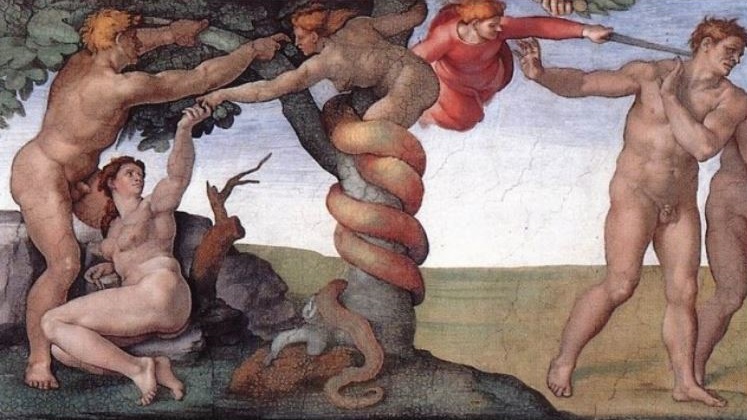
That first sin by our first parents was so cataclysmic that it fundamentally changed the natural order of the world.
A door was opened to chaos: henceforth a price must be paid for being human. Where once was joy and ease, there would be banishment, toil, pain, hardship, sickness, disease, and eventual death (“with painful labor you will give birth to children“; “by the sweat of your brow”; “for dust you are and to dust you will return”). Humankind’s relation with other creatures and the physical environment turned askew as “visible creation has become alien and hostile to man”.
So cataclysmic is the breach that human nature itself became perverted. Henceforth, all of Adam’s progeny would be born with the stain of Original Sin — tinder for sin (fomes peccati) with an inclination to evil. As St. Anselm lamented:¹
I fell before my mother conceived me. Truly, in darkness I was conceived, and in the cover of darkness I was born. Truly, in him we all fell, in whom we all sinned. In him we all lost.
Wrongs require restitution.
The dictionary defines “restitution” as reparation made by giving an equivalent as compensation for loss, damage, or injury caused; indemnification.
So immense was our first parents’ Fall that no man could make amends. Only God Himself, in the person of the Son, could make restitution — by becoming incarnate, only to be tortured, to suffer, and to die on a cross.

That also is a mystery.
Why must it take God Himself to become incarnate in mortal flesh, so as to be tortured and executed in the cruelest method reserved by the Roman Empire for the worst criminals?
This is the answer from the great theologian, St. Thomas Aquinas:²
No mere man could have made satisfaction for the whole race. Yet man owed the debt that had to be paid. Only God could pay the debt, and God did not owe it. Hence it was magnificently right that the payer of the debt, the Redeemer, should be both God and man….
The Incarnation was necessary for man’s salvation. It was not absolutely necessary, for God is almighty, and he could have restored fallen man in other ways. But it was relatively necessary, that is, necessary in relation to the need of bringing redemption to man in the most noble, effective, and admirable way.
How? St. Thomas explains, by:
In remembrance of how Christ our Lord was tortured, suffered, and died for our sins, we are asked to make small sacrifices during Lent via:
Most of all, thank Jesus and tell Him that you love Him with your whole heart, your whole soul, your whole mind, and with all your strength.
May the love and peace of Jesus Christ our Lord be with you,
~E
Footnotes:
¹St. Anselm: Basic Writings, translated by S. N. Deane (La Salle, Illinois: Open Court, 1961), p. 24.
²Msgr. Paul J. Glenn, A Tour of the Summa (TAN Books, 1978), p. 311.
Posted in Christianity, Saints
Tagged Fall of Adam and Eve, Incarnation, Lent, Mark 1, St. Augustine, St. Thomas Aquinas
A year of COVID-19 has had its toll in life expectancy.
Dennis Thompson reports for HealthDay, Feb. 18, 2021, that a new report by the CDC’s National Center for Health Statistics (NCHS), published in the Vital Statistics Rapid Release, found that average life expectancy in the United States took a drastic plunge during the first half of 2020. Overall U.S. life expectancy dropped to 77.8 years, down one full year from the 78.8 years estimated in 2019.
To put those numbers in context, it made headlines when average U.S. life expectancy, after years of steady increases, dropped by just 0.2 years between 2014 and 2015.
For the rest of the post, go to our other alternate blog, Consortium of Defense Analysts — here.
~E
Many find cooking to be relaxing and a great way to save money. Trying new recipes can be fun and many love sharing the fruits of their labor with loved ones!
Have you ever made homemade pasta dough? I have and it’s really a lot easier than one might think. You don’t need a lot of ingredients nor is a pasta maker machine required.
A basic pasta dough recipe includes just a few ingredients:
Here’s some photographs of some of the steps involved from the first time I made homemade noodles:

This is the brand of flour I used and it worked well. Available on the internet.

My dough after mixing/kneading. Should be elastic and a little sticky. Wrap in plastic to rest after kneading.

Dough resting on towels after rolling out flat, to allow to air dry for about 15 or 20 minutes.

Dough after I cut into noodles. I cut my noodles more like chicken noodle soup size as opposed to long spaghetti noodles.

The final fresh product!
Here’s a few easy recipes to try if you have never made homemade pasta dough before: Food Network Easy Pasta, Food & Wine Basic Pasta Dough, and Giada De Laurentiis Fresh Pasta Dough.
If you give it a try, let us know how it turns out! Or if you’ve made pasta dough before, please share any tricks you might use!
DCG
Posted in Uncategorized
Tagged cooking, homemade, homemade pasta noodles, Italian food, pasta
Meet Chunk the Groundhog. He’s found a garden that he (and a buddy) love to visit. Chunk has also found a very easy-going garden owner who lets Chunk take advantage of the bounty.
Chunk lives underneath the shed by the garden and loves to stare into the camera while eating. Chunk’s gotta a pretty good set up!
Chunk’s got his own YouTube page and lots of videoa. Check it out here! Or check out his Instagram account here.
DCG