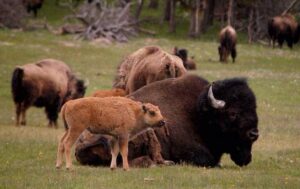
Yesterday we went to our local Oklahoma refuge to try and get a glimpse of a “red dog.”
“Red dog” is a reference to a baby bison. This is due to their “red” (more like orange) color when they are born. Some folk refer to baby bison as “cinny babies” due to their cinnamon-like color.
When baby bison are born, they are red/orange in color and their dark brown coloring develops after a few months. Their “humps” and horns also grow at that time. Read more about the bison here.
Since the babies tend to be born from late March through May, we headed out to the refuge to see if we could spot any “red dog.”
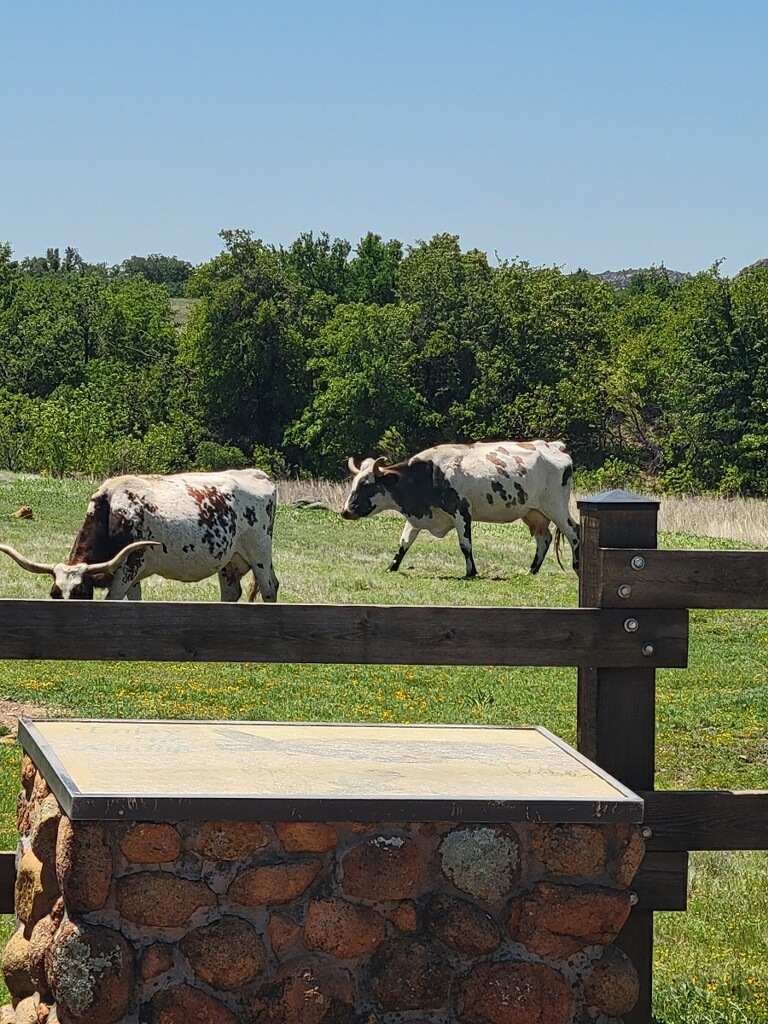
Alas, we did not spot any. We also didn’t spot many prairie dogs as about 50+ Longhorn were passing through prairie dog town.
Texas Longhorns passing through prairie dog town.
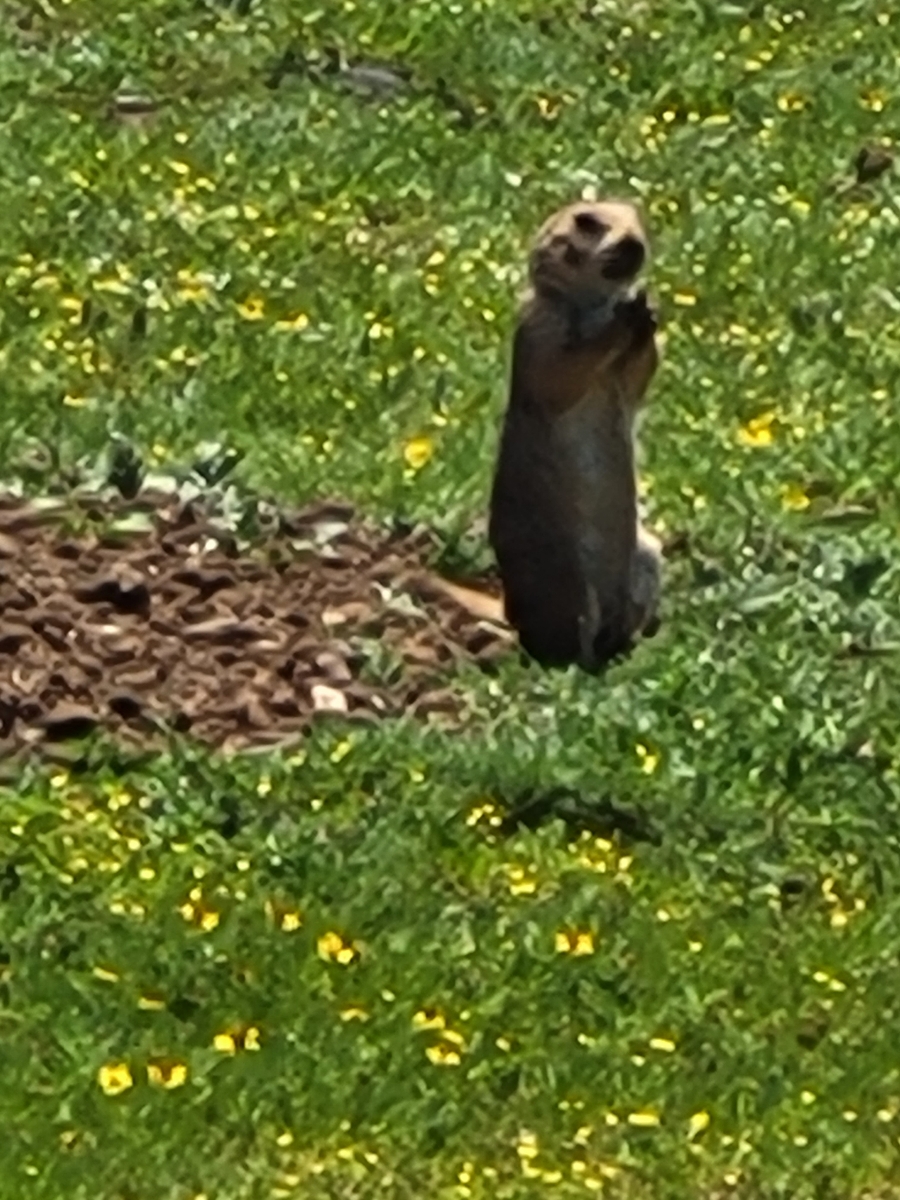
Lone prairie dog keeping an eye on the Longhorns.
But here’s some cute videos of red dogs:
We’ll try again next year and hopefully be able to see some “red dogs!”
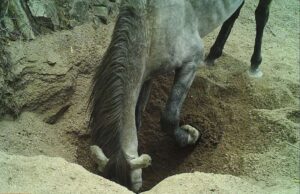
Science Newsreports that donkeys and horses “dig into the dusty sediment to reach cool, crystal clear groundwater to quench their thirst. New research shows this equid ingenuity has far reaching benefits for the ecosystem.”
This provides a major source of water during dry times in the American southwest, benefiting many desert animals. Read their whole report here or watch below:
https://youtu.be/KvoKJJWTNdw
Here’s some video footage that shows many species using the wells:
https://youtu.be/BGG97nLljhk
So fascinating how God’s animals adapt to survive their environments!
The saying, “Like herding cats,” refers to a commonly-held belief that cats cannot be trained or disciplined.
But the amazing Savitsky cats show that trope to be false: Cats can be trained!
Here are the videos of the Savitsky cats from the 2018 America’s Got Talent competition:
https://youtu.be/AZo8kRmAjl4
The Savitsky Cats is a family from the Ukraine that consists of mother Svitlana, daughter Marina, son Misha and their 10 very talented cats: Ulia, Chupa, Topa, Asia, Dasha, Matros, Eddy, Linda, Tosha and Mafik. Svitlana began training her first cat when she was 10 years old.
Sadly, the Savistsky cats were eliminated in the competition’s Quarterfinals. 🙁
An elderly man was hospitalized after suffering a heart attack.
In the days and weeks of his hospitalization, no one came to visit him — not a family member, friend, or acquaintance.
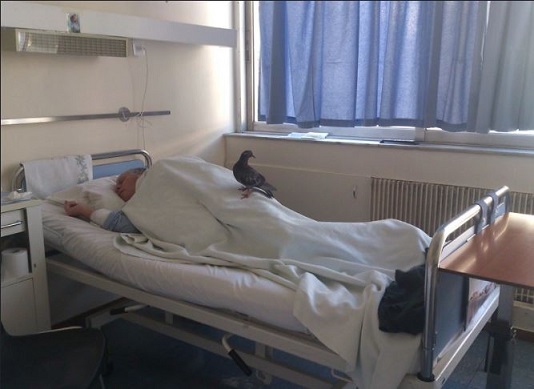
But a pigeon visited him every day, even after the man was moved to another hospital room.
The pigeon would perch on the window sill outside the man’s room, and when the window was opened, would fly in and stand on top of the man.
It was only when the man was well enough to go outside to sit on a bench in a park near the hospital that the attendant nurse found out why.
The man was surrounded by a flock of pigeons, whom he fed with bread crumbs he’d saved from his hospital food.
The pigeon who visited the man must be among the pigeons he’d regularly fed.
And now, the rest of the story. . . .
On January 28, 2021, McKenzie Sadeghi of USA Today conducted a fact check of the story and determined that:
The origin photo for this story, first posted to Facebook, of a pigeon perched on top of a man in a hospital bed was taken years ago by photographer Loannis Protonotarios, an independent filmmaker in Greece.
Protonotarios told The Quint that his father was a patient at the cardiology ward of Red Cross Hospital in Athens, Greece. The man in the photo was a patient who shared the hospital room with Protonotarios’ father. Protonotarios said, “As I was sitting next to my father’s bed I noticed this bird that was sitting atop of this man who was asleep. It was sitting there for quite a while so I took a picture.”
But USA Today claims that “There is no evidence that the man’s family never came to see him or that he fed pigeons at a nearby park. We rate this claim as FALSE. “
Sloppy journalism.
Instead of “false,” the more correct word is “unconfirmed” because USA Today‘s “fact check fellow,” McKenzie Sadeghi, does not know for a fact that (1) the man’s family never came to see him; or (2) the man fed pigeons in a nearby park.
The fact is that USA Today can’t confirm or disconfirm claims (1) and (2). That is a lot different than declaring claims (1) and (2) to be outright false.
In the last analysis, it is interesting and significant that a wild pigeon would fly into a building — a hospital room — and stand on the body of a sleeping man. That is not normal pigeon behavior.
Belgian Shepherds are known to be highly intelligent, alert and sensitive; they are typically highly trainable, with a strong guarding instinct. Hence many are desired for home protection and they are very well suited for security services.
While achieving great jumps they appear to be flying! Check ’em out: