Went to church and witnessed a miracle!
H/t maziel
~E

Went to church and witnessed a miracle!
H/t maziel
~E
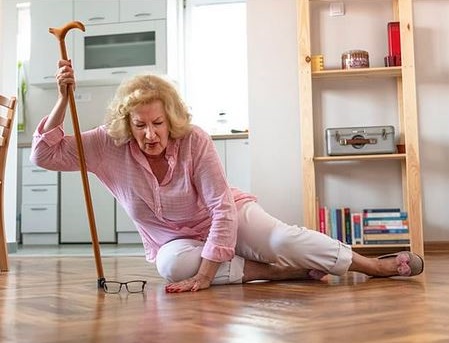
Mobility disability is the leading type of incapacity in the United States and a key contributor to a person’s loss of independence.
According to a recent study of 5,735 ambulatory women aged 63 years and older, one in four women over age 65 is unable to walk two blocks or climb a flight of stairs.
The study was conducted by a team of scientists led by Dr. Nicole Glass at the Herbert Wertheim School of Public Health and Human Longevity Science, University of California, San Diego. The study is published in JAMA Network Open, on February 1, 2021. (See a summary of the study here.)
The researchers followed the women (mean age, 78) for up to six years. Participants wore a research-grade accelerometer for seven days to obtain accurate measures of their physical activity.
The researchers found that even light-intensity physical activity, e.g., shopping or a casual walk, can protect mobility in older women. Those who spent the most amount of time doing such activities were 46% less likely to experience loss of mobility over a 6-year period. While obese and non-obese women all reduced their risk of mobility disability, the benefit was strongest among women with a body mass index (BMI) of less than 30.
Exercise can be as simple as walking.
Walking requires no special equipment, other than a pair of good walking shoes. And it’s free. In fact, experts all say walking is one of the best exercises. Click here for what walking for just 20 minutes does to your body.
(1) Regular aerobic exercise boosts your immune system so that your body better fights illness caused by viruses and bacteria, by:
(2) Regular exercise can reduce your risk of severe COVID-19. (CNBC)
(3) Exercise is good for diabetics (Type 2) by increasing insulin sensitivity and the body’s ability to use glucose as energy. As James G. Beckerman, MD, a cardiologist in Portland, Oregon, says: “In type 2, exercise helps improve insulin resistance. The end result is lower blood sugars.” (Everyday Health)
(4) Exercise is good for our bones: Weight-bearing exercises help build strong bones and prevent osteoporosis.
(5) Dancing (to music) can halt the progression of Parkinson’s disease, i.e., stop the disease from worsening. (Medical News Today)
(6) Exercise helps prevent you from falling by building your lower-body strength. See my post, “Test your balance!”
(7) Exercise is good for our mental health by keeping your brain healthy and protecting it against depression and anxiety (Neuroscience News). See also 8 ways exercise changes your brain (WebMD).
(8) Regular exercise reduces your risk of getting senile dementia, including Alzheimer’s (PubMed; WebMD).
(9) People who walk every day think better, more clearly and more creatively. (Eat This)
(10) Exercise helps you live longer. Exercise is 1 of 3 habits of long-living people. (CNBC)
So put on your walking shoes, step outside, and WALK!
~E
My guy is deployed right now, coming home Saturday. Then a couple weeks later deploying for another mission. Such is the military life…
Yet the homecomings are always the best!
https://youtu.be/IPm9ZviZ8Pc
DCG

Sneaky bastards!
From Eat This, Not That, July 18, 2021:
[McDonald’s] fries are made of more than just Russet Burbank and Shepody potatoes—they also pack in vegetable oil (canola oil, corn oil, soybean oil, hydrogenated soybean oil, natural beef flavor), dextrose, sodium acid pyrophosphate, and salt. And the culprit that’s responsible for cultivating your addiction is the far-from-innocent natural beef flavor. McDonald’s discloses that this savory addition is mostly made up of hydrolyzed wheat and hydrolyzed milk.
While wheat and milk aren’t bad ingredients (unless you have an intolerance), hydrolyzing them—in a process where heat and chemicals break down the foods and produce MSG, which achieves extra appetizing flavors—poses a threat to your tummy. Besides for weight gain and weird allergy-type reactions, MSG also increases appetite by inhibiting your brain from registering that you’re satiated. In fact, one study found that giving laboratory rats MSG increased their food intake by an extra 40 percent!
From WebMD, Feb. 19, 2019:
Monosodium glutamate (MSG) . . . is a seasoning made from sodium and glutamate, an amino acid that’s found naturally in certain foods like tomatoes, soy sauce, and aged cheeses. Glutamate was discovered as a flavor enhancer in 1908 by a Japanese professor. . . . Glutamate is unique because it hits the fabled “fifth taste” called umami (Japanese for “delicious”), a decidedly savory and meaty flavor. The professor filed for a patent to produce MSG, and it became widely used to season food. . . .
[I]n the 1990s, the FDA asked an independent scientific group to investigate. The group concluded that MSG is safe, though they said some sensitive people might get short-term symptoms (like headache or drowsiness) if they consume 3 grams or more of MSG (a typical serving in food is less than .5 grams). The FDA classifies MSG as “generally recognized as safe”, the same designation that ingredients like sugar and baking soda have. They say the body metabolizes MSG the same way it does the natural glutamate found in food. Also of note: The International Headache Society no longer includes MSG on their list of headache triggers.
~E
Belgian Bus Company’s very funny commercials:
~E
The apostles gathered together with Jesus
and reported all they had done and taught.
He said to them,
“Come away by yourselves to a deserted place and rest a while.”
People were coming and going in great numbers,
and they had no opportunity even to eat.
So they went off in the boat by themselves to a deserted place.
People saw them leaving and many came to know about it.
They hastened there on foot from all the towns
and arrived at the place before them.
When he disembarked and saw the vast crowd,
his heart was moved with pity for them,
for they were like sheep without a shepherd;
and he began to teach them many things.

“People were coming . . . in great numbers . . . the vast crowd”
Have you ever wondered how a “vast crowd” could hear Jesus’ words?
In Luke 9’s account of Jesus’ multiplication of a few loaves and fishes to feed the huge crowd who came to listen to Him, we are told that “the men there numbered about five thousand.” (Luke 9:14)
How did a crowd of 5,000 manage to hear Jesus without the devices of modern technology of microphone, speakers, and amplifiers?
That surely was a miracle unreported in the Gospels.
A woeful characteristic of the Gospels is how sketchy their accounts were. There is no physical description of Jesus the Christ — not His hair color, eye color, or how tall He was.
The accounts are succinct, using an economy of words.
But we are told in Mark 6 that in a non-technological age wherein news was communicated mainly via word of mouth, multitudes of people “from all the towns” got word of Jesus going to a place. So eager were they to see and hear Him, they arrived “on foot” even before Jesus and the Apostles.
Today’s so-called superstars who fill sports stadiums cannot begin to be compared to our Lord.
And may the peace and love of Jesus Christ our Lord be with you,
~E

For over a month now my 19-year-old kitty “Baby” has been scratching and itching like crazy. He’s got patches of hair missing from his body and seems a little miserable. 🙁
First time we took him to the vet they gave him an allergy shot to control the itch. He was back at the vet the following week for another allergy shot. At the first visit, Baby had a couple red spots on his skin and they have disappeared. The red spots have not come back.
Third time I took Baby to the vet I was told that the problem was “psychological.”
We do have two other cats that Baby does not interact with, Little Black Kitty and Cujo. LBK and Cujo were abandoned by neighbors and we adopted them. They both came into our lives in 2018, shortly before Baby’s brother “Lucky” passed away in December 2018.
Now, after almost three years with these other cats, Baby appears to be fearful of/irritated with them. He seems to be looking for them when exiting a room and he’s taken to itching pretty badly.
I’ve tried some new foods for skin/fur issues, every “calming” product available at PetSmart, and Dinovite. I now keep Baby isolated from LBK and Cujo as much as possible although I’m sure he can still hear and smell them. Nothing is stopping his itching.
Have you ever had an itch issue with a cat like this before? If so, how did you handle it?
Any suggestions you may have would be greatly appreciated. I know my Baby is very senior in cat years and I would like to make his last months (maybe year?) as comfortable as possible.

Baby in 2015 showing off his mouser skills.
THANKS!
DCG
Here’s a stress-buster 🙂
And this is what a newborn owl looks like:

~E
https://youtu.be/3EkOKqZ57LA
DCG
Posted in dogs, Funnies, God's creation