What happens when your cat bites/eats a toad?

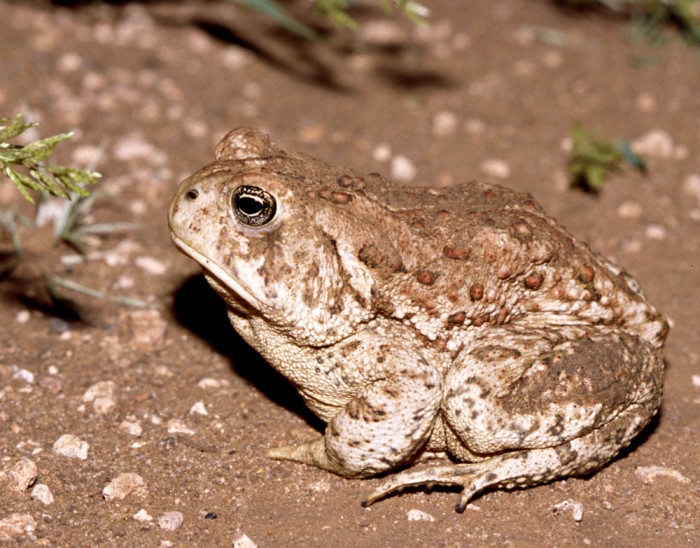
Here in Oklahoma we have a lot of Woodhouse toads. They come around on our front porch at night to feast on the bugs and stick around on the front porch during the day.

None of my cats ever chase these toads and I always wondered why. That question was answered today when a co-worker told me about the wonderful self-defense mechanisms God gave frogs and toads!

The co-worker told me that cats and dogs stay away from these creatures because they stink. And they are toxic to our pets. From HowStuffWorks:

“Nature provides all life with some means of protection. With certain toads it is the saliva, which is thought to contain a potent toxin. The poison contained in a toad’s saliva is so strong that once it comes in contact with the mouth or eyes of the cat, it causes severe symptoms within minutes.

Toad poisoning affects the heart and nervous system to such a degree that death can occur within 30 minutes if the cat is not treated. Some warning signs that indicate your cat has experienced toad poisoning include excessive drooling, a shaking head, trembling and shaking body, lack of coordination, difficulty breathing, convulsions, and coma. Signs may develop around the mouth or eyes of the cat immediately after contact with the toad.”

My co-worker told me that most cats and dogs “foam at the mouth” and have drooling and vomiting. The cure for a cat that has been afllicated by biting/eating a toad or frog is to flush their eyes/mouth with water. If it was me, I’d be getting kitty to the vet ASAP.

Here’s what it looks like when a cat eats a frog:

So glad I learned about this today. And very happy that my cats have the good sense to stay away from the toads!

DCG

Sunday Devotional: ‘Blessed is the womb that carried you’

Luke 11:27

While Jesus was speaking,
a woman from the crowd called out and said to him,
“Blessed is the womb that carried you
and the breasts at which you nursed.”

Today, the universal Church celebrates the Assumption of the Blessed Virgin Mary, Mother of God.

The Assumption of Mary is, according to the beliefs of the Catholic Church, Eastern Orthodox Churches, Oriental Orthodoxy, Church of the East, and some Lutheran and Anglo-Catholic Churches, among others, the bodily taking up of Mary, the mother of Jesus, into Heaven at the end of her earthly life.

Tim Staples writes in Catholic Answers, August 12, 2019:

The doctrine of the Assumption of Mary began with a historical event to which Scripture alludes and… believed in the Church for 2,000 years…. Let us examine the facts:

1. Archaeology has revealed two tombs of Mary, one in Jerusalem and one in Ephesus. The fact that Mary lived in both places explains the two tombs. But what is inexplicable apart from the Assumption is the fact that there is no body in either tomb. And there are no relics. Anyone who peruses early Church history knows that Christian belief in the communion of saints and the sanctity of the body…led early Christians to seek out with the greatest fervor relics from the bodies of great saints. Cities, and, later, religious orders, would fight over the bones of great saints.

This is one reason why we have relics of the apostles and so many of the greatest saints and martyrs in history. Yet never was there a single relic of Mary’s body? As revered as Mary was, this would be very strange, except for the fact of the assumption of her body.

2. On the historical front, Fr. Michael O’Carroll, in his book, Theotokos: A Theological Encyclopedia of the Blessed Virgin Mary, writes:

We have known for some time that there were widespread “Transitus Stories” that date from the sixth century that teach Mary’s glorious Assumption….  L’Assomption (p. 59).

Fr. [A.A.]Wenger [in his book L’Assomption] found a Greek manuscript that verified what scholars had previously believed to be true. Because there were whole families of manuscripts from different areas of the world in the sixth century that told a similar story of Mary’s Assumption, there had to be previous manuscripts from which everyone received their data. Fr. Wenger discovered one of these earlier manuscripts, believed to be the source later used by John of Thessalonica in the sixth century in his teaching on the Assumption….

Recently discovered Syriac fragments of stories about the Assumption of Mary have been dated as early as the third century. And there are undoubtedly more manuscripts to be found. It must be remembered that when we are talking about these “Transitus stories,” we are not only talking about ancient manuscripts and fragments of manuscripts, but we are talking also about two different “families” of manuscripts written in nine languages. They all agree on Mary’s Assumption and they presuppose that the story was already widely known….

Since the time of the promulgation of the dogma of the Assumption of Mary, there has been much new discovery. We now have written evidence of belief in the Assumption of Mary as far back as the third century…. [N]ew historical discoveries continue to be made and once again . . . and again . . . and again, they confirm the Faith of our Fathers.

 May the peace and love of Jesus Christ, our Lord, be with you!

~E

Ivermectin effective against COVID-19

NOTE: This post is for information purpose and should not be regarded as a medical prescription. You alone are responsible for any action you may undertake from reading this post.

——————————————————————————————-

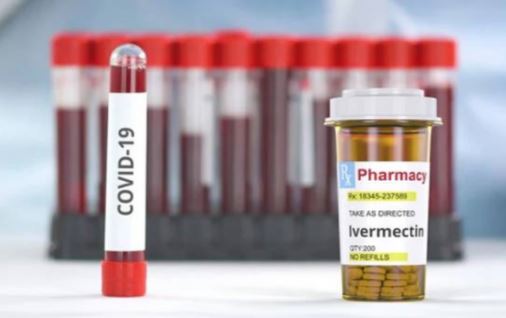
According to the federal government’s NIH (National Institutes of Health), ivermectin is a Food and Drug Administration (FDA)-approved antiparasitic drug that is widely used to treat several tropical diseases, including onchocerciasis, helminthiases, and scabies; it is also being evaluated for its potential to reduce the rate of malaria transmission by killing mosquitoes that feed on treated humans and livestock.

Although (1) ivermectin has been shown to inhibit the replication of SARS-CoV-2 in cell cultures, and (2) some clinical trials and observational cohorts have found ivermectin to be effective in preventing and treating the COVID-19 coronavirus (data from some of these studies can be found in Table 2c, the FDA has not approved ivermectin for the treatment of any viral infection, claiming “there is insufficient evidence for the COVID-19 Treatment Guidelines Panel to recommend either for or against the use of ivermectin for the treatment of COVID-19.” (Source: NIH)

However, independent scientists and physicians disagree with the NIH:

  • As early as December 2020, Paul Marik, MD, a professor and chief of the division of pulmonary and critical care medicine at Eastern Virginia Medical School, said that studies indicate ivermectin to have “demonstrated efficacy” in preventing COVID-19 infection prior to and after exposure to the coronavirus, and that the drug has been shown to effectively treat the virus in the early symptomatic stages and among patients hospitalized with COVID-19. Dr. Marik called ivermectin “remarkable” and “a gift to us”–“a safe drug that is exceedingly cheap.”
  • A study by a team of scientists found a 5-day course of ivermectin to be safe and effective in treating adult patients with mild COVID-19. Their study is published in the February 2021 issue of the peer-reviewed International Journal of Infectious Diseases (here).
  • An even more recent study of bibliographic databases up to April 25, 2021, published in the July-August 2021 issue of the peer-reviewed American Journal of Therapeutics (here), concluded that:

Moderate-certainty evidence finds that large reductions in COVID-19 deaths are possible using ivermectin. Using ivermectin early in the clinical course may reduce numbers progressing to severe disease. The apparent safety and low cost suggest that ivermectin is likely to have a significant impact on the SARS-CoV-2 pandemic globally…. Health professionals should strongly consider its use, in both treatment and prophylaxis [prevention].

There are also many anecdotal accounts, both online and from my contacts, of the effectiveness of ivermectin for the treatment of early onset COVID-19.

Amazon.com requires that you have a doctor’s prescription in order to purchase ivermectin. But there is a website that doesn’t (click here).

Business Insider warns that “While smaller doses of the medication [ivermectin] can be tolerated by humans, with few side effects…, taking a dose of ivermectin intended for an animal the size of a compact car [like a horse] can poison you. According to the Missouri Poison Center, serious overdoses of ivermectin can result in seizures, coma, lung issues, and heart problems.”

In studies of ivermectin given to patients with COVID-19, here’s the protocol or plan (Healio):

In the protocol, those at high risk for COVID-19 infection receive ivermectin at 0.2 mg/kg on day 1 and day 3, and weekly for 4 weeks…. For early outpatients with COVID-19, the protocol calls for one dose of ivermectin at 0.2 mg/kg at day 1 and day 3….

Update (January 28, 2022):  The recommended dosage above is way too complicated. I searched online and found a simpler prescription: 12 mg of ivermectin a day for 5 days.

NOTE: This post is for information purpose and should not be regarded as a medical prescription. You alone are responsible for any action you may undertake from reading this post.

~E

Americans with Ph.D.s are least likely to get COVID-19 vaccine

Coronavirus vaccination tyranny is upon us (see a post on this, forthcoming).

Most of the media coverage would have you believe that the reported surge in  the Delta coronavirus variant cases is mainly due to those less educated Trump “morons” (i.e., supporters) who don’t want to take the vaccine.

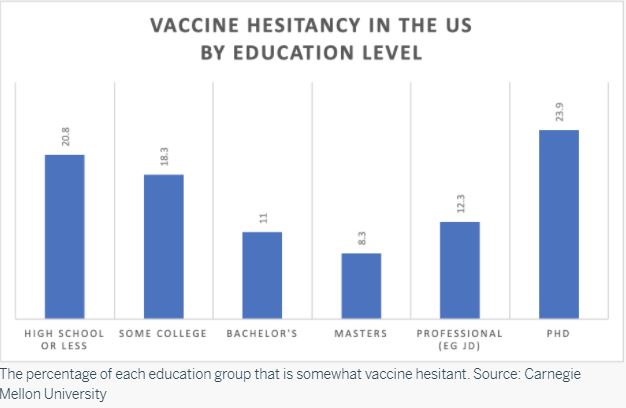
But according to a new paper by researchers from Carnegie Mellon University and the University of Pittsburgh, it turns out that Americans with a doctoral degree are the most skeptical about the vaccine, and the least likely to get vaccinated.

Intelligence is moderately correlated (r=0.39-0.44) with educational achievement (see here). Those with PhD, LLD, MD and DDS degrees have the highest IQs of all education levels — an average IQ of 124 (see here). This means that the most intelligent Americans are the most skeptical about the coronavirus vaccine(s).

As reported by the UK’s Unherd, August 11, 2021, the study analyzed more than 5 million survey responses by Americans of different demographic details, including education level, and classed those people who would “probably” or “definitely” not choose to get vaccinated as “vaccine hesitant.”

While the study did find a correlation between counties with higher Trump support in the 2020 presidential election and higher vaccine hesitancy (in the period January 2021 — May 2021), the association between vaccine hesitancy and education level follows a U-shaped curve with the highest hesitancy among those least and most educated. People with a master’s degree had the least hesitancy, and the highest hesitancy was among those holding a Ph.D. 

In the first five months of 2021, the largest decrease in hesitancy was among the least educated — those with a high school education or less. However, hesitancy held constant in the most educated group — those with a Ph.D. degree.

So not only are the most educated people most skeptical of taking the COVID vaccine, they are also the least likely the change their minds about it. For the reasons why, see my post of June 9, 2021, here.

~E

Thursday funnies!

DCG

Start your Monday with a chuckle…

DCG

Sunday Devotional: Be kind to one another

Ephesians 4:30-5:2

Brothers and sisters:
Do not grieve the Holy Spirit of God,
with which you were sealed for the day of redemption. 
All bitterness, fury, anger, shouting, and reviling
must be removed from you, along with all malice. 
And be kind to one another, compassionate,
forgiving one another as God has forgiven you in Christ.

So be imitators of God, as beloved children, and live in love,
as Christ loved us and handed himself over for us
as a sacrificial offering to God for a fragrant aroma.

This Sunday’s reading from St. Paul’s letter to the Ephesians exhorts us to “be imitators of God”.

Just as Jesus love us so much He sacrificed Himself so that we may be redeemed and have access to a life after death in Heaven, we are exhorted to also “live in love” by removing all “malice…bitterness, fury, anger, shouting, and reviling” from ourselves, and instead “be kind to one another”.

What does kindness mean?

Being kind is defined as “harboring a spirit of helpfulness, as well as being generous and considerate, and doing so without expecting anything in return. Kindness is a quality of being.”

Note that the above definition doesn’t specify the recipient of our kindness must be human. Being kind isn’t species-specific.

Being kind isn’t just for the benefit of others, human and nonhuman (animals). It turns out that being kind is good for us!

Science has found evidence that being kind is:

(1) Good for our body:

  • Kind people tend to be healthier and live longer. 
  • Being kind can decrease blood pressure and cortisol, a stress hormone. When we are under stress, our bodies release cortisol, which increases blood sugars. While small increases in cortisol have positive effects on our response to stress by giving us a quick burst of energy, heightened memory and a lowered sensitivity to pain, increased cortisol levels caused by chronic stress can decrease immune functioning, increase weight gain and difficulty losing weight, and increase blood pressure, cholesterol and risks of heart disease. Sustained cortisol increases can actually harm the brain and impair thinking, memory and learning, which is why people under chronic stress can “go blank” and be forgetful. (Michigan State University)

(2) Good for our mental wellbeing:

  • Kindness can increase our sense of connectivity with others, which  elevates our mood and alleviates loneliness — a widespread epidemic in our time, exacerbated by government-imposed COVID-19 lockdowns and “social distancing”.
  • Kindness increases self-esteem, empathy and compassion.
  • Physiologically, kindness can positively change our brains by boosting dopamine, serotonin, and endorphins:
    • Dopamine, a “feel-good” chemical, is a chemical messenger in the brain that can give us a feeling of euphoria, and is credited with causing what’s known as a “helper’s high.”
    • Oxytocin, sometimes called “the love hormone,” is the hormone mothers produce when they breastfeed, cementing their bond with their babies. Oxytocin is also released when we’re physically intimate. Oxytocin plays a role in forming social bonds, making us more trusting, more generous, and friendlier, while also lowering our blood pressure.
    • Serotonin is a neurotransmitter that helps regulate mood.
    • An endorphin-like chemical in our body called substance P can relieve pain.

But for the above beneficial effects to last, kindness can’t be a single act. Being kind is most beneficial as a practice—something we work into our daily routine whether in the form of ongoing volunteer work, donating to worthy causes, random acts of kindness like feeding an expired parking meter for a stranger, bringing a snack to share with friends and colleagues, or feeding the homeless, human or animal.

Sources: Mayo Clinic; Cedars Sinai

May the peace, kindness and love of Jesus Christ, our Lord, be with you!

~E

Happy Friday! Watch kayaker rescue an osprey

Luvs a happy ending!

DCG

The ‘I’m not that fat’ Caption Contest

This is our 246th world-famous Caption Contest!

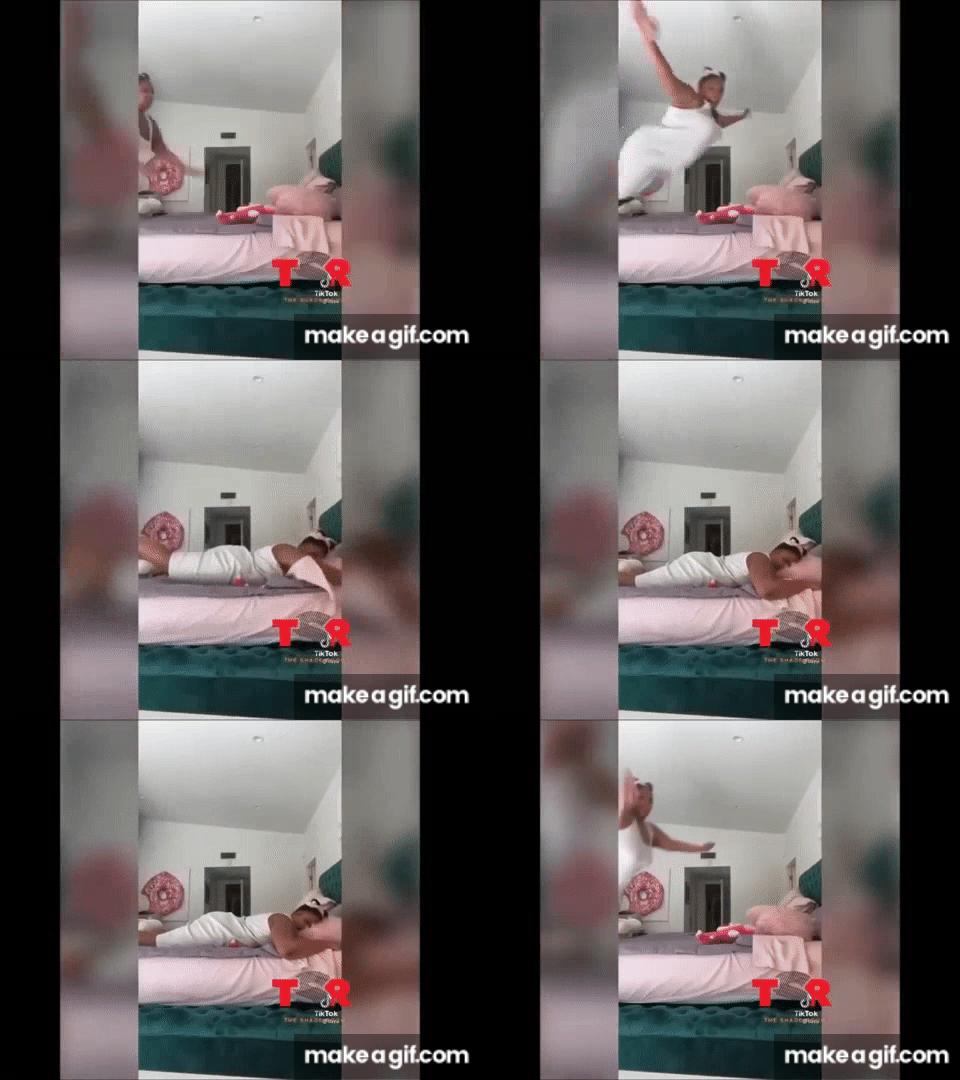
Here’s the GIF:

Lizzo Belly Flop

About the GIF: Lizzo is a rapper who is proud of being fat, and is lauded for her “body positivity”. There is a rumor that at one of her shows, she dove into the crowd and crushed a member of the audience to death. Lizzo went on TikTok to dispel the rumor by bellyflopping on her bed to show she’s not so fat that she could have crushed someone to death. She said: “I’ve never stage dived in my life. Ya’ll really gon put that on my motherf****ng name? Like, I know I’m big but, b***h, I’m not that f****ng big.” (Source)

Lizzo

You know the drill:

  • Enter the contest by submitting your caption as a comment on this thread (scroll down until you see the “LEAVE A REPLY” box).
  • Body and Soul‘s writers will vote for the winner.
  • Any captions proffered by our writers, no matter how brilliant (ha ha), will not be considered. :(

This contest will be closed in two weeks, at the end of Tuesday, August 17, 2021.

To get the contest going, here’s my caption:

“There she blows!” cried the lookout, sighting the great white whale, Moby Dick.

For the winner of our last Caption Contest, go here.

~E

We have a winner!

. . . for our 245th Caption Contest!

This was an easy contest for our writers because there were so few entries. LOL

Our writers have voted for their respective #1 (best) and #2 (next best) captions. Each #1 vote is worth 4 points; each #2 vote is worth 2 points.

And the winner of our 245th Caption Contest, with three #1 votes and one #2 votes, totaling 14 points is . . .

Truckjunkie!

Here is the winning caption:

Uh, Meghan, you don’t need to strike that pose until you’re ready to have the baby…..

Jackie Puppet is in 2nd place, with one #1 vote and one #2 vote, totaling 6 points:

Alexis, wanna see a real vagina?

vett and AZgeo are in 3rd place, each with 4 points:

vett (one #1 vote): “Are you hungry? I brought a box lunch for you.”

AZgeo (two #2 votes): “EW, worms! Will have to clean that thing again.”

Brian Heinz is in 4th place, with one #2 vote and 2 points:

Hey dad, can we move up the seats, someone spilled a sardine can over here and smells like someone is fanning it up in the air.

WELL DONE, EVERYONE!

Congratulations, truckjunkie!!!

For all the other caption submissions, go here.

Be here later today for our next, very exciting Caption Contest!

~E